ALVAN Journal of Psychological Research and Human Development Open Access  |  Yearly  |  ISSN: XXXX-XXXX
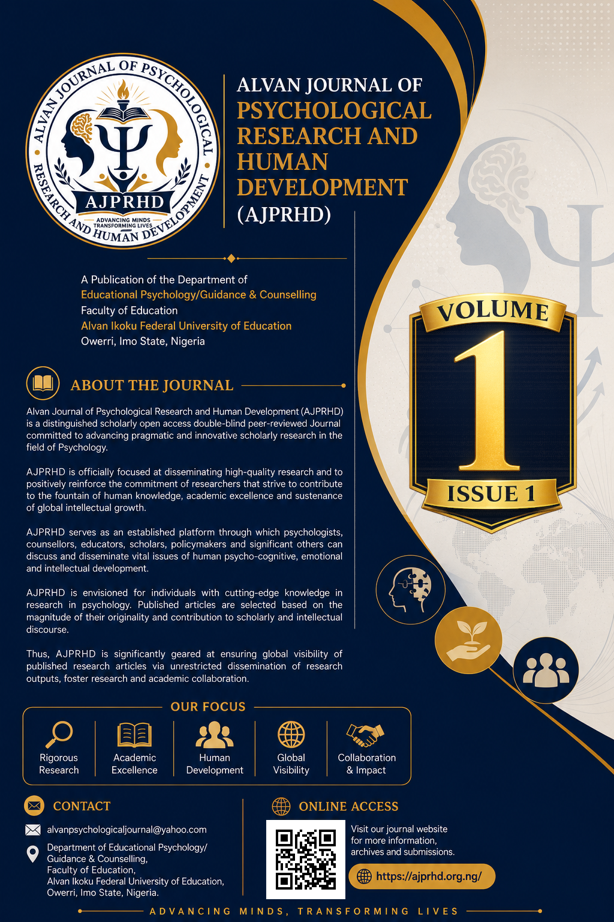
Vol. 1, No. 1 Cover
Current
Current Issue

Vol. 1, No. 1 (2026)

July 13, 2026 8 Articles Open Access
All Issues

Table of Contents

ALVAN Journal of Psychological Research and Human Development Vol. 1, No. 1, 2026 July 2026
pp. 1-14
Effects of Separate and Combined Chronic Administration of Energy Drinks and Alcohol on Grooming Behaviour in Male Albino Wistar Rats
Jackson I. Osuh * , Shyngle K. Balogun , Femi E. Babalola
Grooming behaviour is a reliable indicator of central nervous system (CNS) functioning frequently used to assess behavioural and neurochemical responses to psychoactive substances. This study examined the separate and combined effects of energy drinks and alcohol on grooming behaviour in male Albino Wistar rats. Using a randomized experimental design, twenty-eight rats were assigned to four groups (n = 7): energy drink, alcohol, combined energy drink and alcohol, and control. Treatments were administered orally once daily for 28 consecutive days. Upper- and lower-body grooming behaviours were recorded daily and systematically quantified. Data were analyzed using descriptive statistics, one-way ANOVA, repeated-measures ANOVA, two-way mixed ANOVA, and Least Significant Difference (LSD) post hoc tests. Descriptive analyses showed that control animals displayed the highest grooming frequencies, whereas rats exposed to the combined treatment exhibited the lowest grooming activity. Although one-way ANOVA revealed no significant overall group differences (p > .05), LSD post hoc comparisons indicated significant reductions in lower-body and mean grooming in the combined group relative to controls (p < .05). Repeated-measures analysis demonstrated a significant main effect of time and a significant Group × Day interaction (p < .001), indicating treatment-dependent variations in grooming patterns across the exposure period. A significant main effect of grooming type was also observed, with upper-body grooming occurring more frequently than lower-body grooming. These findings suggest that chronic co-administration of alcohol and energy drinks disrupts grooming behaviour with suggestions for further neurochemical research and public awareness.
pp. 15-25
Appraisal of TETFund Intervention on Human Resources as Correlate of Infrastructural Development of Tertiary Institutions in Imo State.
Rita Chigozie Osuala * , Racheal Ukachi Urenyere , Okoiye Ojaga Emmanuel , Camillus Ugochukwu Ekeh
In this study, the researchers investigated TETFund intervention on human resources as correlate of infrastructural development in tertiary institution in Imo State. Two research questions and two hypotheses were formulated and tested using simple linear approach at 0.05 level of significance. The design adopted was correlation research design. The population consist of three thousand three hundred and sixty-four (3,364) lecturers from the seven state and Federal owned tertiary institutions in Imo State, the sample was three hundred and thirty-six (336) lecturers which is 10% of the population drawn through cluster and proportionate random sampling techniques. The instruments are two rating scales titled “Tertiary Education Trust Fund Scale (TETFS) and Infrastructural Development Scale (IDS). The instruments were validated by two Measurement and Evaluation experts and reliability established to be 0.76 and 0.74 for TETFS and IDS respectively using crombach alpha statistics. Pearson product moment correlation coefficient (Pearson r) statistics was used to test the hypotheses at 0.05 level of significance. Findings showed that both provision of research/publication and academic staff training have moderate, positive and significance relationship with infrastructural development in tertiary institutions in Imo State. It was recommended among others that government should continue to encourage and support research activities, staff training and infrastructural development through TETFund intervention.
pp. 26-36
EFFECTS OF REALITY AND RATIONAL EMOTIVE BEHAVIOUR THERAPIES IN IMPROVING REGULAR SCHOOL ATTENDANCE BEHAVIOUR AMONG TRUANTS' SECONDARY SCHOOL STUDENTS IN AJEGUNLE, LAGOS STATE
Kehinde Funmilola Adebisi *
This study investigated effects of reality and rational emotive behaviour therapies in improving regular school attendance behaviour among truants' secondary school students in Ajegunle, Lagos State, while considering the moderating effect of age and gender. The study adopted a pre-test, post-test control group quasi experimental design with 3x2x2 factorial matrix. The design is made of three rows representing the two treatment techniques, reality therapy and rational emotive behaviour therapy and the Control Group (non-treatment group). The two treatment groups were exposed to eight-weeks training in Emotional Intelligence and Cognitive Restructuring Training, while participants in the control group received no training. The sample for the study comprised of sixty secondary school students (male and female) who are truants and have consistently absented from school 15 times in each term (first and second term) without permission as recorded in their school attendance register. Participants were purposively selected based on their absenting record for two terms. One validated instrument: Regular School Attendance. Questionnaire (a= 0.82) was used. Three hypotheses were tested at 0.05 level of significance. Data was analysed using Analysis of Covariance. There was significant main effect of treatment in the pre-post school attendance behaviour scores among secondary school truants' students in the experimental and control groups (F (3,56) = 5.538, P < .05). Also, there was significant moderating main effect of age in the pre-post regular school attendance behaviour scores among secondary school truants' students between older and younger students (F (2,57) = 8.923, P < .05). Likewise, there was significant moderating main effect of gender in the pre-post regular school attendance behaviour scores of truants' secondary school students (F (2,57) = 2.244, P < .05). School counselling psychologists could adopt the two interventions to manage challenges of truancy among secondary school students.
pp. 50-62
Effects of Cognitive Restructuring Therapy and SQ3R Strategy among Secondary School Students in Gombe State, Nigeria
Solomon Garba *
This study was carried out to determine the effects of cognitive restructuring therapy (CRT) and survey, question, read, recite, review (SQ3R) study strategy on academic procrastination among secondary school students in Gombe State, Nigeria. A pre-test post-test non-equivalent no control group design was adopted for the study. To guide the study, three research questions were answered, and three hypotheses were tested at 0.05 level of significant. Population of the study was 24,478 secondary school students in the 142 public coeducation schools in Gombe State, and the sample for the study was 134 students in the public co-education schools in Gombe State, drawn using the purposive sampling technique. There were two experimental groups. The experimental group 1was exposed to cognitive restructuring therapy on academic procrastination, while the experimental group 2 was exposed to SQ3R study strategy on academic procrastination. The study made use of three research instruments – a 25-item academic procrastination scale (APS), and two experimental packages. The APS was validated by five experts. The test of stability of APS was ensured using test-retest method on twenty students at an interval of two weeks. The Pearson Product Moment Correlation was used to ensure the reliability of APS at 0.05 level of significant. APS yielded a reliability index of 0.72. Cronbach Alpha was also used to test the internal consistency of APS and the coefficients of internal consistency 0.84. All the experimental groups were exposed to pre-test and then after the administration of the various treatments, were exposed to post-test. The data obtained were analyzed using Mean and Standard Deviation for answering research questions and Analysis of Covariance for testing hypotheses at 0.05 level of significance. Major findings of the study revealed that CRT and SQ3R study strategy had significant effects on academic procrastination levels of secondary school students in Gombe State; and that gender was a factor of significant difference in academic procrastination in favour of male. It was concluded that academic procrastination is effectively managed using CRT and SQ3R study strategy among secondary school students. The study recommended among others that CRT and SQ3R study strategy should be used by school counsellors/psychologists, teachers and other Education stakeholders in managing academic procrastination among secondary school students.
pp. 63-78
Peer Influence as a Social Mechanism for Fostering Positive Behaviour Against Bullying Tendencies Among Students in Basic Education, Delta State
Joseph Obiajuru *
This study explored the impact of peer influence as a social mechanism for fostering positive behaviour against bullying tendencies among students in Upper Basic Education, Delta state. Two research questions were answered and two hypotheses tested. The study employed ex post facto, descriptive and correlational research. 40,204 students in Upper Basic II Education in Delta State constitute the population of the study. 380 students were sampled for the study. Two instruments were used for data collection titled: Peer Influence Scale and Bullying Behaviour Scale. The collected data were analyzed with descriptive statistics (Mean and Standard Deviation), Multiple Correlation and Multiple Regression Statistics. The study revealed that on the basis of components of peer influence, yielding to Peer Pressure significantly increase bullying among the students while resistant to peer pressure and peer encouragement can mitigate bullying behaviour problem. The findings also show a significant difference in bullying tendencies between male and female students, with female students exhibiting higher bullying behaviours compared to their male counterparts. The study concludes that resistant to peer pressure and peer encouragement can mitigate bullying behaviour problem. The study advocate for development of social resistance skills, since encouraging young adolescents to build resistance to negative peer pressure is essential for their personal and social development. Programmes that enhance decision-making, assertiveness, and self-confidence will equip young people to make independent and positive choices.
pp. 79-91
The Efficacy of Rehearsal and Cognitive Therapies on the Management of Juvenile Delinquency Among Senior Secondary School Adolescents, in Benin Metropolis of Edo State
Gladys Ifeyinwa Nwokwule * , Patricia Eghe Ima-Osagie
Juvenile delinquency among adolescents remains a growing concern within secondary schools in Nigeria, particularly in urban centers such as Benin Metropolis, Edo State. This study examined the efficacy of rehearsal therapy and cognitive therapy in the management of juvenile delinquent behaviours among senior secondary school adolescents. The study used quasi experimental research design. The targeted population of the study consisted of Eighteen thousand, and twelve (18,012) public mixed Senior Secondary School Adolescents in Benin Metropolis. A sample size of one hundred and thirty-three (133) adolescents were selected from the population through multi-stage sampling technique. An instrument titled "Juvenile Delinquency Assessment Scale (JDAS)" was used. The validity of the instrument was established by three test experts, two from Counselling Psychology, and one from Measurement and Evaluation, in the Department of Educational Evaluation and Counselling Psychology. A Reliability coefficient value of 791 was obtained using Cronbach's alpha statistics. The data collected were analyzed using paired sample t-test statistics, one way analysis of variance Two-way ANOVA, including Post Hoc multiple comparison. The study revealed that there were significant differences in the Pre-test and Post-test mean scores in the management of juvenile delinquency of Senior Secondary School adolescents, when exposed to CBT, RT and Control group at post-test. This shows that the two treatment packages, Cognitive Behavioural Therapy and Rehearsal Therapy that were used in modifying juvenile delinquency, were effective. It was recommended that Counsellors, and Psychologists should make use of Cognitive behavioural therapy and Rehearsal therapy in assisting students and clients who exhibit acts of juvenile delinquency.
pp. 92-100
Influence of Continuous Assessment on Teaching and Learning Process in Secondary Schools in Imo State, Nigeria
Ngozi Yvonne Olefolu * , Gilbert N. Alaribe
This study investigated the influence of continuous assessment on teaching and learning process in secondary schools in Imo State, Nigeria. To achieve the aims of the study, two research questions were asked and two corresponding hypotheses were formulated and tested at 0.05 level of significance. The study adopted the correlation research design. The population of the study is 94,963 students in 296 public senior secondary schools in Imo State. A sample of 398 students was drawn from 15 selected schools through Taro Yamane using simple random sampling technique. Two researcher-made rating scales titled “Continuous Assessment Scale (CAS)” and “Teaching and Learning Process Scale (TLPS)” were used as instruments for data collection. These instruments were validated by three research specialists. Reliability coefficients of 0.81 for CAS and 0.85 for TLPS were obtained using Cronbach Alpha statistics. Research questions were answered using Pearson Product Moment Correlation Coefficient (PPMCC) while the hypotheses were tested using t-test of the significance of Pearson “r”. The results revealed that continuous assessment has a high, positive and significant coefficient of relationship with students’ learning outcomes and attitude in public senior secondary schools in Imo State. It was concluded that continuous assessment as a crucial tool for enhancing student learning outcomes and attitudes provides regular feedback that informs instruction and motivates students to learn. Based on these results, it was recommended among others that teachers should prioritize regular, well-designed continuous assessments in order to provide actionable feedback to students and inform teaching practices, helping to boost learning outcomes.
pp. 37-49
SOCIO-ECONOMICS DETERMINANTS OF GENDER DISPARITY IN TECHNOLOGY EDUCATION: EMPIRICAL INSIGHTS FROM FEMALE STUDENTS IN POLYTECHNICS, SOKOTO STATE, NIGERIA
Alhaji Ladan Sirajo * , Amegwa Omama Aliyu
This study examined socio-economic factors predicting gender disparities in technology education among female students of Umaru Ali Shinkafi Polytechnic, Sokoto State, Nigeria. A mixed-methods design was adopted, combining descriptive survey and phenomenological approaches. The study population consisted of 596 final-year female students across six technology-related programmes. Using stratified random sampling, a sample of 234 students was selected, while 13 females were purposively chosen for in-depth interviews. Two instruments were employed: a structured questionnaire (SPFGDTEQ) and an interview guide. Content validity was established through expert review and reliability of 0.71 was obtained using Cronbach's alpha. Data were analyzed using descriptive statistics (mean score) for the quantitative aspect, while qualitative data were subjected to thematic analysis. Findings revealed that high educational costs, limited household income and lack of scholarships significantly constrain female participation in technology education. The study concluded that socio-economic barriers remain central to female underrepresentation in technical fields. It recommends the establishment of targeted scholarships and subsidized tuition plans to reduce financial burdens and promote equitable female participation in technology education.

* Corresponding author

Issue Information
Volume Vol. 1
Issue No. 1
Year 2026
Published July 13, 2026
Articles 8
ISSN (E) XXXX-XXXX
Access Open Access
Sections
Research Article 7
Case Study 1
Cite This Issue
ALVAN Journal of Psychological Research and Human Development (2026). Vol. 1, No. 1. Department of Educational Psychology/Guidance & Counselling. ISSN: XXXX-XXXX.
Share This Issue